
By Jocelyn Bayliss, Senior Vice President, Provider Network Management and Ashleigh Majdeski, Vice President, Provider Network Operations & Performance
When a surveyor calls a provider listed as in-network and the number doesn’t work, that provider goes unevaluated. That isn’t a neutral outcome. It’s a provider who may well have met the standard and a positive result the plan never gets to count. In ATTAC’s 2026 QHP secret shopper surveys, that it happened more often than anything else: 23% of outcomes, ahead of every other cause.
Between January and May, our surveyors called the providers of multiple Marketplace issuers and tried to schedule an appointment the way a member would. CMS requires those calls to be placed as secret shopper surveys by an independent third party, with results reported in June. ATTAC survey calls are made by trained human surveyors, many of whom came from provider relations or health plan backgrounds before joining us.
New Patient appointment wait time standards for Marketplace issuers have been in place since January 1, 2025: 10 business days for behavioral health and 15 for routine primary care, with 90% of appointments meeting the standard. A 30-business-day standard also exists for non-urgent specialty care, but CMS does not yet require specialty providers to be surveyed.
Invalid provider phone numbers led every other reason in QHP secret shopper surveys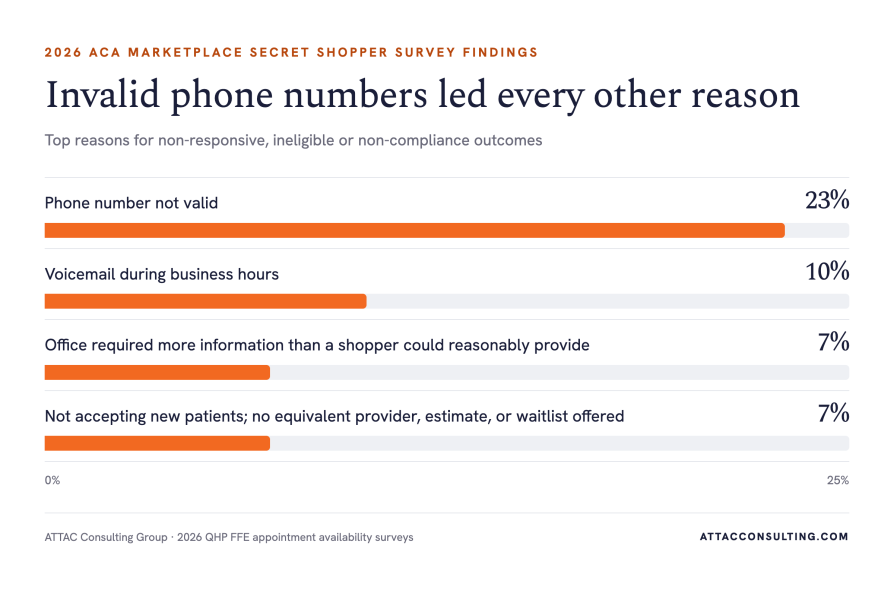
While invalid phone numbers accounted for 23% of non-responsive provider survey outcomes, voicemail during posted business hours accounted for another 10%.
Neither has anything to do with whether an appointment was available. In the first, our surveyor dialed a number listed as in-network and it was a wrong number. In the second, the practice was open, but the call went to voicemail during business hours — and under CMS methodology we can’t leave a message.
In both cases the provider went unevaluated. Each one is a chance at a positive result the plan didn’t get to collect.
That matters because the two are different problems with different fixes, and both impact the amount of reserves needed to achieve the minimum threshold. A capacity gap takes contracting and recruitment. A bad directory record takes provider data management.
Our surveyors flag every one of these: the disconnected lines, the wrong addresses, the providers who have retired or moved. The flags go back to the plan as provider directory corrections — the same corrections the No Surprises Act already requires.
QHP appointment wait times ran about 50% past the CMS standard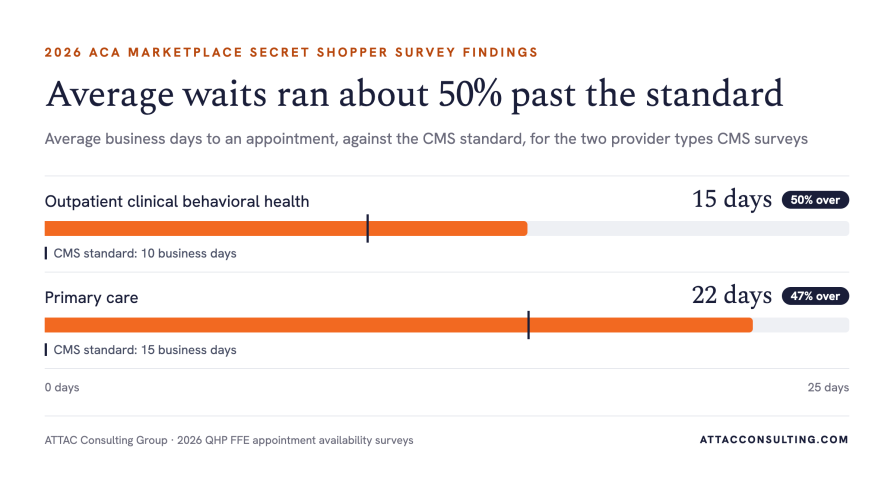
Outpatient clinical behavioral health averaged 15 business days to an appointment, against a 10-day standard. Primary care averaged 22 business days, against a 15-day standard.
Appointment wait times varied nearly fourfold by market
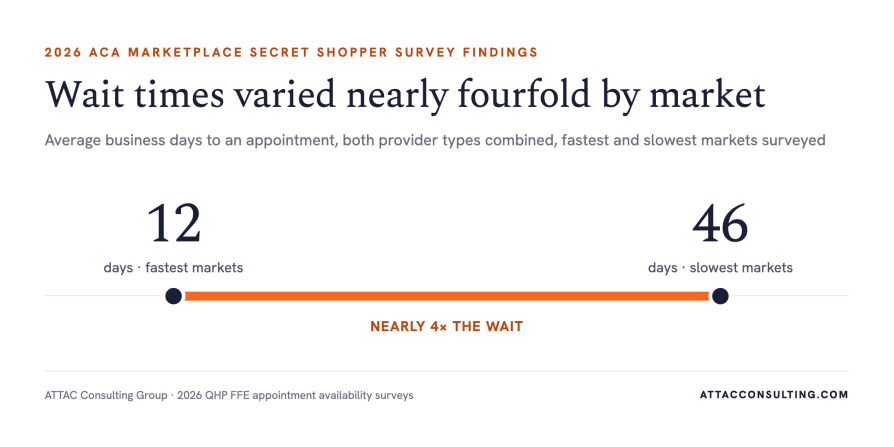 Across both provider types combined, the fastest markets we surveyed averaged about 12 business days to an appointment. The slowest averaged about 46 — under the same federal standard, in the same survey cycle.
That gap is why we report at the region, MSA, county, and network level rather than as a single national figure. A rolled-up average can’t tell a network team where to put its remediation effort.
Three things to do before the 2027 QHP secret shopper cycle
-
Correct the provider demographic records your 2026 survey already flagged — and correct them before the files go out
The last practical checkpoint is the Provider Population File CMS sends each fall: if a phone number on it is wrong, it can be fixed before the file goes to your survey vendor. A number corrected at that point is a provider your surveyor can actually reach. The same corrections count toward your directory accuracy and No Surprises Act work.
-
Educate the people who actually book the appointments
The requirement lands on practice scheduling staff, not on the physician. Make sure they know what the standard is and what’s being asked of them, so any gaps surface before the survey does. At the same time, confirm provider demographics — especially the phone number used for appointment setting, which is often invalid on the directory record. Calls that reached voicemail during posted business hours were another 10% of the outcomes we tracked.
-
Focus provider relations on your slowest markets first
Average waits across the markets we surveyed ranged from about 12 business days to about 46. Sort your 2026 results by market and provider type, and start outreach where the waits are longest.
If your report only gives you a compliance rate, ask your vendor for provider-level outcomes and reasons now, while there’s still time to use them.
Compliance is the floor. Let’s help you reach the ceiling.
ATTAC’s provider network team does this work for marketplace plans. Our phased survey process runs the QHP secret shopper survey, reports why each provider missed, and follows with provider education for the practices that need it. Our provider data management team corrects the records the survey flags. The 2027 survey window opens January 1 — connect with us now to get more ROI from your next survey cycle.
Figures in this post are aggregated across multiple unrelated Marketplace issuers and do not represent any individual plan’s results. They are average business days to a first offered appointment, not compliance rates — a plan’s CMS score is the percentage of providers meeting the standard, which is a different measure. Figures cover the two provider types CMS currently surveys. The outcome reasons shown are the most common of a larger set of CMS codes and are not a complete distribution.
 Jocelyn Bayliss is Senior Vice President, Provider Network Management at ATTAC Consulting Group, where she leads the firm’s provider network development and management practice, including its access and availability survey engagements, across Medicare, Medicaid, and commercial programs. Her work covers large-scale provider network contracting, network development strategy, and directory maintenance. Before joining ATTAC she held senior roles at WellCare Health Plans and Florida True Health, and served as chief operating officer of a Florida ACO.
 Ashleigh Majdeski is Vice President, Provider Network Operations & Performance at ATTAC Consulting Group, where she leads provider access surveys, network adequacy analysis, and provider data quality work for health plan clients. She has more than 30 years in Medicare, Medicaid, and commercial network operations, and has led statewide expansions and network adequacy contracting builds across multiple states. Before moving to consulting she held leadership roles at Universal American and AmeriHealth Caritas.